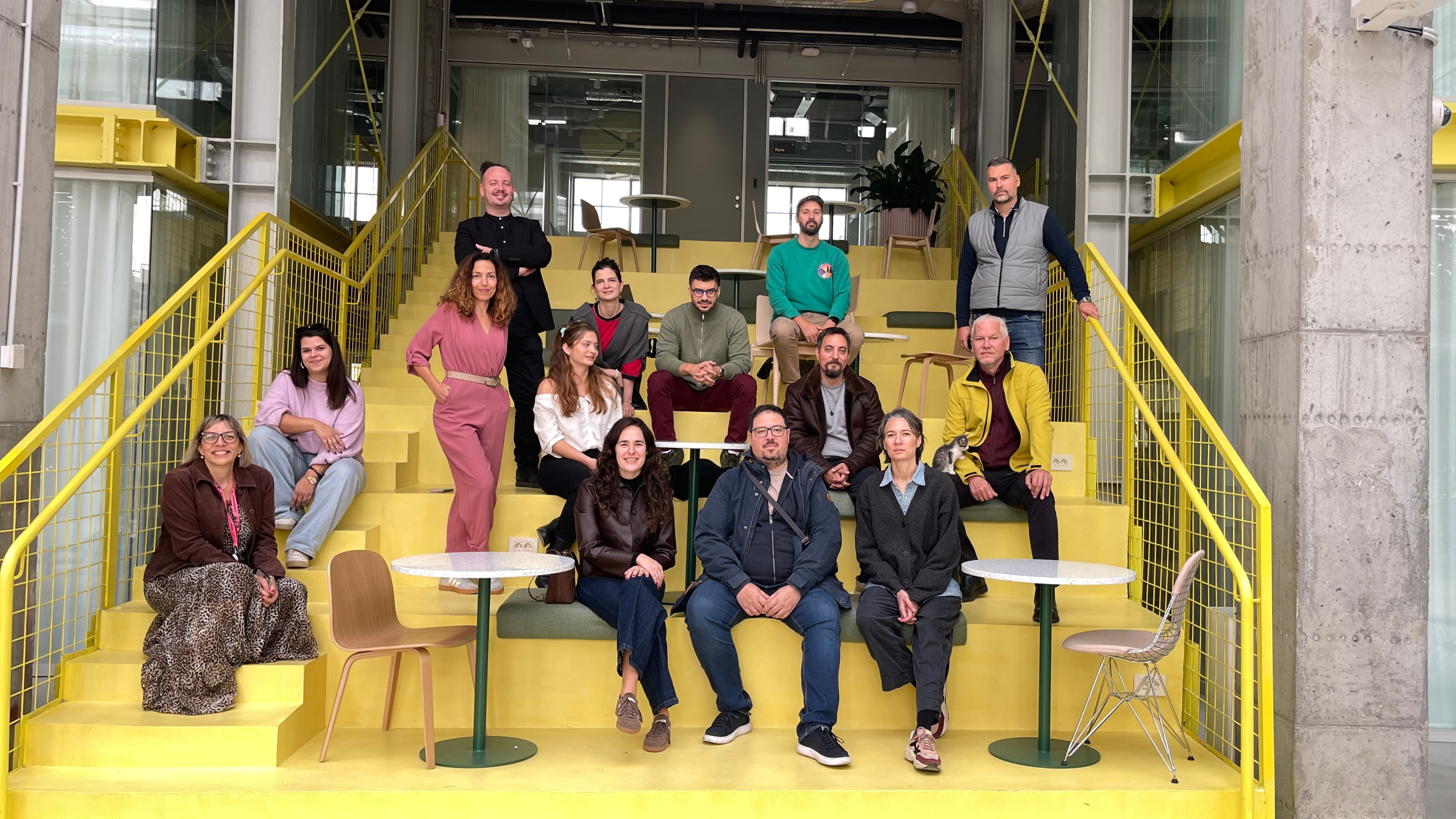
Partnering on the Creative Engine project gave us the opportunity to explore new tools, acquire contemporary skills and develop pilot projects for the future production of immersive content. The collaboration between Ložionica, the Serbian Film Association, London-based motion capture studio Centroid and the expert team at Materriya Talent Development brought together professionals from different fields around a shared goal: creating a new educational program dedicated to the development of immersive experiences.
By combining gaming technologies, digital characters, immersive sound and spatial design, participants explored new production processes and collaborative models. A total of 38 young producers, actors, audio and 3D specialists worked on stories inspired by the industrial heritage of Ložionica, connecting performance, sound and digital tools in the production of a prototype immersive experience.
We spoke with the program mentors to better understand what participants had truly learned, the challenges they encountered throughout the process, and how these skills are already finding their place in projects emerging across Serbia and the Western Balkans.
Motion Capture and Digital Performance
For the first time in the region, actors had the opportunity to gain hands-on insight into the preparation, technical tools and challenges of working in a motion capture environment. Through project analysis, technical exercises and on-location shooting simulations, participants developed and brought to life characters inspired by different eras of industrial development in Serbia.
Slobodan Danilović, animator and mentor of the digital performance workshop, explains that the biggest challenge was learning how to see an avatar in the “mocap mirror.”
“It seemed to me that our participants were quickest to grasp the most demanding concept: the animator’s approach to stage movement. They became especially interested in the biomechanics of movement and the subtle details that define different types of motion. The greatest challenge becomes controlling an anatomically different avatar using your own body movements, because that kind of retargeting requires a lot of practice.”
Danilović adds that Serbia’s video game industry is rapidly growing and that the demand for actors experienced in motion capture performance will continue to increase.
“Following the workshop, auditions were already organized for several gaming projects, and actors from the region have already been hired. I believe the growing awareness of mocap performance will also inspire projects in digital theatre, film and TV production.”
Creating Digital Humans and Working in Unreal Engine
The following module, dedicated to metahuman creation, was led by Darko Subotin, who highlights that one of the program’s greatest values was the opportunity to work within realistic production conditions.
“Technology is advancing incredibly fast, and tools for creating digital humans are becoming far more accessible. This gives creative power back to artists, allowing them to focus more on expression rather than overcoming technical limitations.”
One of the key challenges for participants was balancing creative expression within clearly defined production frameworks.
“Paradoxically, creativity often becomes clearer when certain limitations exist. That is precisely why this program offered such valuable experience in teamwork and real-world production environments.”
Speaking about the application of these skills beyond the gaming industry, Subotin emphasizes that participants’ knowledge can be applied across film, advertising, interactive media, educational applications and various forms of visual communication based on real-time technologies.
Immersive Sound Design as Narrative
When discussing the immersive sound design module, mentor Miloš Martinov explains that one of the most important realizations for participants was understanding that sound is not simply an addition to a project, but an equal part of the narrative itself.
“In most student projects, sound comes at the very end of the process, once other creative elements have already been defined. In projects like this one, sound plays a much larger role in narration, direction and overall creativity.”
Over the course of just four days, the team created the project’s complete soundscape, including original music, rich atmospheric layers, vivid sound effects for five different scenes set across multiple eras, and additional foley effects recorded and edited specifically for the experience.
“A group of people who mostly didn’t know each other managed, through teamwork and mutual support, to create a complex and coherent sound experience in a very short period of time. I’m incredibly proud of the energy and dedication every participant brought into the process.”
The Digital Twin of the Water Tower
The final module focused on creating a digital twin of the Ložionica Water Tower and integrating it into the overall immersive experience.
Mentor Dane Blačić points out that working in Unreal Engine allows participants to develop and test projects in real time, without the need for lengthy rendering processes.
“This allows them to experiment more freely with space and to think about audience experience as the foundation of storytelling.”
As a result of the work of more than 30 participants, a digital model of the Ložionica Water Tower and a concept for its interior were created, offering a foundation for future immersive projects and new creative experiments within the space.
A New Space for Future Productions
Creative Engine opened up new possibilities for connecting disciplines, technologies and professional practices that increasingly intersect within contemporary production.
By working on concrete tasks and a shared project, participants gained experience in an environment that closely reflects real production workflows, while also exploring how the future of film, gaming, sound and performance can evolve through collaboration.